
Modular Vertical Farming Hardware
Controlled-environment agriculture hardware engineered for predictable harvests. Not presented as an off-the-shelf product — currently undergoing rigorous sensor and hydrology calibration in our R&D testbed.
Why Vertical Farming is Part of Our Data Work
Field agriculture is inherently variable: unexpected heat spikes, fluctuating soil microbiomes, and localized micro-climates make it difficult to isolate baseline plant mechanics.
A controlled vertical setup produces clean, repeatable data on water consumption, light absorption spectrums, temperature thresholds, relative humidity, and vegetative growth rates. By understanding exact nutrient uptake curves in this calibrated baseline, we improve our field diagnosis algorithms.
Every rack functions as a physical telemetry lab, testing closed nutrient loops that can later support urban growers and resilient peri-urban supply chains across Central India.
- 1.Water Uptake: Exact litres transpired per kg of leafy biomass.
- 2.Photon Efficiency: Biomass yielded per photon of 450nm/660nm LED light.
- 3.EC & pH Dynamics: Nutrient depletion rates across vegetative intervals.
- 4.Vapour Pressure Deficit: Foliar transpiration under controlled humidity.
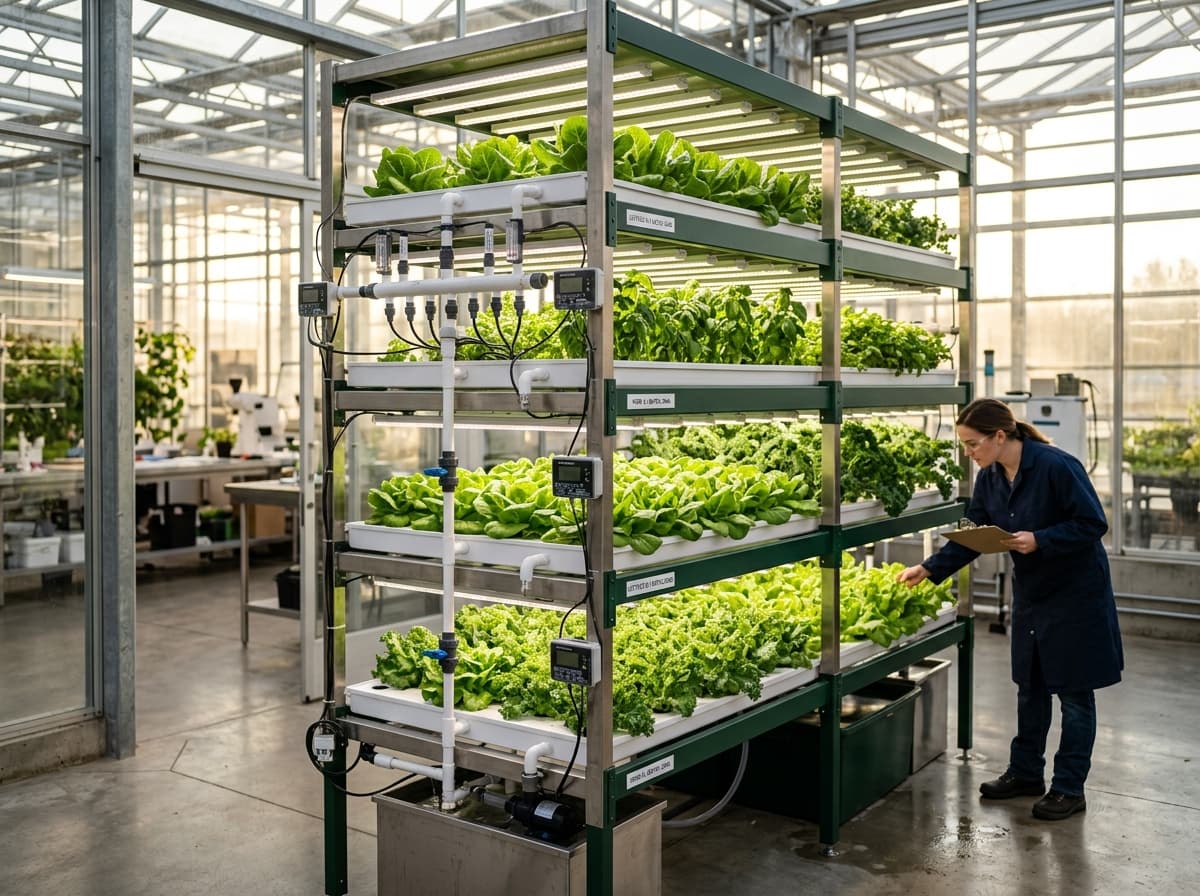
Anatomy of a Prakruty Vertical Rack
Tap or hover each component to inspect its physical engineering role and the precise environmental telemetry it records.
Narrow-Spectrum Horticultural LED Bars
What It Does (Hardware Function)
Dual-channel LED bars emitting balanced 450nm royal blue and 660nm deep red photon spectrums. Delivers uniform photosynthetic active radiation (PAR) across every plant cup with passive aluminium thermal heat sink dissipation.
Operating photoperiod hours, junction temperature (°C), lumen output degradation telemetry, and instantaneous wattage draw.
Engineering Specifications
Interactive Resource Estimator
Model expected monthly inputs and harvests based on rack units and target crop varieties.
Source note: [XX] Internal terrace prototype telemetry vs 900L flood baseline
180 L/month
94.2% water saved vs 3600L open-field flood
Placeholder coefficient: [45 litres/month/rack]72 kg/month
Pesticide-free foliar harvest every 28-day cycle
Placeholder coefficient: [18 kg/month/rack]2.9 m² (~31 sq ft)
Standard 1.2m × 0.6m rack footprint
Placeholder coefficient: [0.72 sq. metres/rack]272 kWh/month
For LED photoperiod and micro-pump duty cycle
Placeholder coefficient: [68 kWh/month/rack]Planning Note: Planning estimate only. Actual results depend on crop, climate and setup.
Benefits Kept Honest
No marketing hyperbole. Four grounded engineering advantages of closed-loop vertical systems.
Recirculated Water Loop
Conserves 94.2% of irrigation water compared to open-field flood techniques. A 4-tier rack requires only 40L of monthly top-up water.
Space-Saving Vertical Density
Stacks 4 to 5 tiers in an 8 sq ft footprint (1.2m × 0.6m). Allows rooftop terraces, abandoned rooms, and basement utility areas to match the harvest of 85 sq ft of open soil.
Climate Isolation
Protects tender micro-greens and herbs from Chhattisgarh's 44°C summer heatwaves, unseasonal hail, torrential monsoon downpours, and wandering foliar pests.
Year-Round Harvests
Consistent 28-day harvest cycles regardless of external weather. Provides stable fresh salad greens and herbs without off-season market price volatility.
Frequently Asked Questions
Clear technical answers regarding hardware readiness, plumbing, and pilot testing.
Need Structural Specs & Pilot Timelines?
Request our preliminary engineering pack with dimensional CAD drawings, pump schematics, and pilot participation criteria.